From the BugSpeaks gut microbiome test you will learn which microbes live in your gut and what they can do. You get a 48-page report with more than 100 indicators and a 12-week nutrition plan calculated from your own microbes. You take the sample at home in about 5 minutes, and the report is in your account within 16 working days of receiving your sample.
What makes this test different?
It starts with how the sample is read. The Leucine Rich Bio laboratory uses shotgun metagenomic sequencing, which reads the DNA in the sample without pre-selection: from bacteria, archaea, fungi and viruses. It compares that DNA with a reference database of 247,728 genomes and identifies a microbe down to species level when there is enough of its DNA. The detection limit is about 0.001% of the sample.
The commonly used 16S method reads a section of one gene. It sees only bacteria and archaea and says little about what they can do. When the two methods were compared on the same stool sample, shotgun analysis identified more bacterial species and found more genes. In the same comparison, longer reads identified species more accurately, and the laboratory's Oxford Nanopore sequencer reads DNA in exactly that way, in long stretches.
The result is a report with more than 100 indicators that draws on about 80 scientific references. Here is how its 48 pages are divided:
What is in the 48 pages of the report
- Introduction and summarypp. 1–4
- Functions and health indicatorspp. 5–14
- References and notespp. 46–48
Of the 48 pages, 19 are about the microbes by name, 12 about the nutrition plan, 10 about what the microbes can do and the health indicators, 4 about the introduction and the summary with the Rych Index, and 3 about the references and notes.
Source: BugSpeaks gut test sample report, Bulgarian edition, table of contents (p. 2)
What will you learn about your microbes?
The report has 7 sections. They contain 60 functional and health indicators, 36 foundation, 42 probiotic and 52 opportunistic species and a check for 90 antibiotics, 280 entries in total. The indicators and species are compared with reference groups of healthy people from different parts of the world. The “Summary Results” section brings the most important things together on two pages:
- “Rych Index”: Leucine Rich Bio’s own index from 0 to 100. It brings together diversity, your microbes’ potential to produce beneficial substances and the balance between beneficial and opportunistic microbes. With a repeat test you see how it changes.
- “Your Gut Scorecard”: on one page you see which indicators are low, optimal or above optimal, the levels of the five health indicators and the antibiotics your microbes carry resistance genes for. Next to it are the probiotic species that are under-represented in you and the opportunistic microbes whose share is above the average for healthy people.
What can your microbes produce?
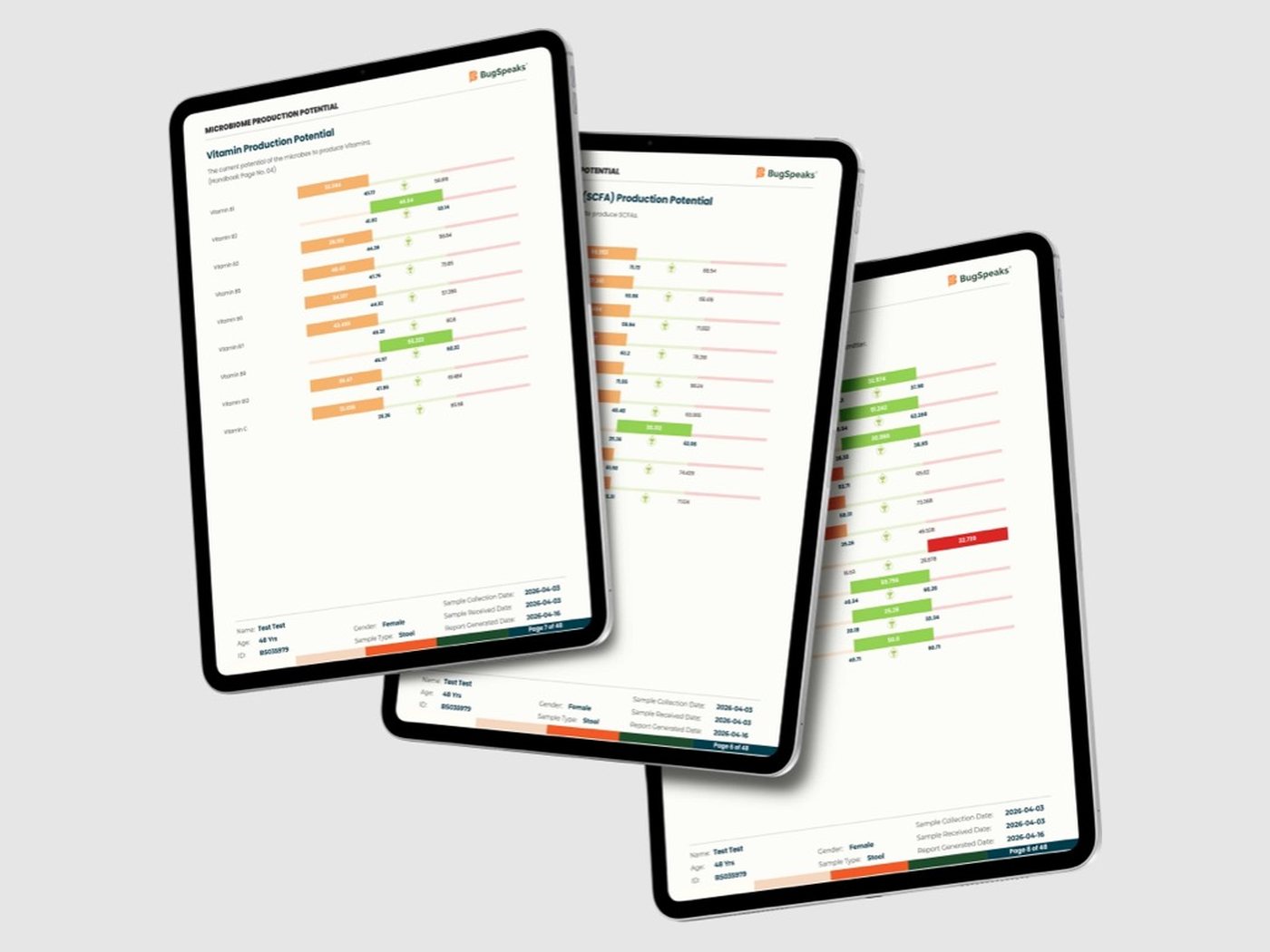
Gut microbes turn food into substances your body uses. The report shows their potential for 28 of them, each compared with healthy people:
- “Short Chain Fatty Acid (SCFA) Production Potential”: acetate, propionate, butyrate, isobutyric, valeric, isovaleric and 2-methylbutyric acid, formate and caproate. Microbes make most of them from the fibre in your food.
- “Vitamin Production Potential”: vitamins B1, B2, B3, B5, B6, B7, B9, B12 and C.
- “Neurotransmitter Production Potential”: acetylcholine, dopamine, epinephrine, GABA, glutamate, histamine, norepinephrine, serotonin, tryptamine and tryptophan. Research links these substances with the gut–brain axis.
What do your gut microbes do?
Here the report shows how your microbes help your digestion and your body:
- “Macronutrient Metabolism Potential”: how your microbes break down carbohydrates, fats and proteins.
- “Gut Function”: “Intestinal Motility Potential” is about how your gut moves, and “Mineral Bioavailability Potential” about the absorption of iron, zinc and calcium.
- “Intolerance Management”: how your microbes help or hinder the breakdown of lactose, fructose, gluten and histamine. It is not an intolerance test, but the plan uses this data to arrange your foods.
- “Endurance Potential”: aerobic and physical endurance, that is, how much your microbes support physical activity.
What do your microbes say about your health?
Here the report brings together five health indicators, each on three levels: low, moderate or high. So you see where your microbes work for you and where it is worth helping them with your diet.
- “Prone to Fatigue”: whether your microbes help you against fatigue.
- “Leaky Gut Potential”: how strong your gut barrier is according to your microbes.
- “Potential Gut Inflammation”: whether microbes linked to inflammation dominate in your gut.
- “TMAO Production Potential”: how much your microbes turn the carnitine and choline in your food into TMA, which the liver turns into TMAO.
- “Microplastic Exposure Indicator”: species and genes in your microbiome that research links to exposure to microplastics.
A separate section compares your microbes with the microbial profiles seen in people with 8 common conditions and shows, as a percentage, how closely they resemble each other. The conditions are type 2 diabetes, obesity, hypertension, non-alcoholic fatty liver disease, constipation, irritable bowel syndrome, inflammatory bowel disease and rheumatoid arthritis. It is not a diagnosis and does not predict whether you will develop any of them, but it shows which profiles your microbes resemble and what to keep an eye on.
Which microbes live in your gut?
Here are the microbes themselves, by name. The share of each species is compared with reference groups of healthy people from different parts of the world:
- “Shannon Diversity”: how diverse the microbial community in your gut is.
- “Kingdom Distribution”: what share of your microbiome is bacteria, archaea, fungi, single-celled and multicellular eukaryotes and viruses.
- “Foundation Microbiota”: 36 species on which the balance of the whole microbiome depends, including Faecalibacterium prausnitzii, Prevotella copri and three Roseburia species.
- “Probiotic Characterization”: 42 probiotic species, 21 lactobacilli, 7 bifidobacteria and 14 others, including Akkermansia muciniphila, Saccharomyces boulardii and Lactobacillus bulgaricus, which is used to make yoghurt. In the “Probiotic Supplementation Summary” each species gets a label: whether to consider a supplement, follow the recommendations, carry on as you are or avoid supplements with it.
- “Opportunistic microbes”: the share of 52 species that are usually present only in small amounts in healthy people: 25 bacteria, 12 fungi, 11 protozoa and 4 worms. They include Helicobacter pylori, Clostridioides difficile and Candida albicans. This is the share of their DNA in the sample, not a test for infection and not a diagnosis.
- “Antibiotic Recovery Potential”: how well your microbiome would recover after a course of antibiotics.
- “Antibiotic Resistance”: which known resistance genes for 90 antibiotics and antimicrobial substances your gut bacteria carry. This is general information about your microbiome, not an antibiogram.
- “Top 5 Abundant Species”: which five species dominate in each of the five kingdoms at the time of the test.
All 36 foundation species
- Agathobaculum butyriciproducens
- Alistipes finegoldii
- Alistipes putredinis
- Alistipes shahii
- Anaerostipes hadrus
- Bacteroides caccae
- Bacteroides dorei
- Bacteroides ovatus
- Bacteroides stercoris
- Bacteroides thetaiotaomicron
- Bacteroides uniformis
- Bacteroides vulgatus
- Barnesiella intestinihominis
- Bifidobacterium adolescentis
- Bifidobacterium longum
- Blautia obeum
- Blautia wexlerae
- Collinsella aerofaciens
- Coprococcus catus
- Coprococcus comes
- Dorea formicigenerans
- Dorea longicatena
- Eubacterium eligens
- Eubacterium hallii
- Faecalibacterium prausnitzii
- Fusicatenibacter saccharivorans
- Gemmiger formicilis
- Odoribacter splanchnicus
- Parabacteroides distasonis
- Parabacteroides merdae
- Prevotella copri
- Roseburia faecis
- Roseburia intestinalis
- Roseburia inulinivorans
- Ruminococcus bromii
- Ruminococcus torques
All 42 probiotic species
Lactobacilli (21)
- Lactobacillus acidophilus
- Lactobacillus amylovorus
- Lactobacillus bulgaricus
- Lacticaseibacillus casei
- Lactobacillus caucasicus
- Lactobacillus crispatus
- Lactobacillus delbrueckii
- Lactobacillus gallinarum
- Lactobacillus gasseri
- Lactobacillus helveticus
- Lactobacillus jensenii
- Lactobacillus johnsonii
- Lacticaseibacillus paracasei
- Lactobacillus pentosus
- Lactobacillus lactis
- Lactiplantibacillus plantarum
- Lacticaseibacillus rhamnosus
- Levilactobacillus brevis
- Ligilactobacillus salivarius
- Limosilactobacillus fermentum
- Limosilactobacillus reuteri
Bifidobacteria (7)
- Bifidobacterium adolescentis
- Bifidobacterium animalis
- Bifidobacterium bifidum
- Bifidobacterium breve
- Bifidobacterium infantis
- Bifidobacterium lactis
- Bifidobacterium longum
Other probiotics (14)
- Akkermansia muciniphila
- Bacillus clausii
- Bacillus coagulans
- Bacillus indicus
- Bacillus subtilis
- Clostridium butyricum
- Enterococcus faecium
- Lactococcus lactis
- Leuconostoc mesenteroides
- Pediococcus acidilactici
- Saccharomyces boulardii
- Saccharomyces cerevisiae
- Streptococcus salivarius
- Streptococcus thermophilus
All 52 opportunistic species
Bacteria (25)
- Campylobacter jejuni
- Clostridioides difficile
- Escherichia coli
- Helicobacter pylori
- Plesiomonas shigelloides
- Salmonella enterica
- Shigella dysenteriae
- Vibrio cholerae
- Vibrio parahaemolyticus
- Vibrio vulnificus
- Yersinia enterocolitica
- Bacillus cereus
- Enterococcus faecalis
- Listeria monocytogenes
- Pseudomonas aeruginosa
- Staphylococcus aureus
- Staphylococcus epidermidis
- Staphylococcus saprophyticus
- Streptococcus agalactiae
- Streptococcus pneumoniae
- Citrobacter freundii
- Fusobacterium nucleatum
- Klebsiella pneumoniae
- Mycobacterium avium
- Proteus mirabilis
Fungi (12)
- Aspergillus flavus
- Aspergillus fumigatus
- Aspergillus nidulans
- Aspergillus niger
- Aspergillus terreus
- Candida albicans
- Candida glabrata
- Candida krusei
- Candida parapsilosis
- Candida tropicalis
- Geotrichum
- Microsporidia
Protozoa (11)
- Blastocystis hominis
- Chilomastix mesnili
- Cryptosporidium
- Cyclospora cayetanensis
- Dientamoeba fragilis
- Endolimax nana
- Entamoeba coli
- Entamoeba histolytica
- Giardia intestinalis
- Pentatrichomonas hominis
- Toxoplasma gondii
Worms (4)
- Ancylostoma duodenale
- Ascaris lumbricoides
- Necator americanus
- Trichuris trichiura
This is the share of their DNA in the sample, not a test for infection.
All 90 antibiotics and antimicrobial substances
- Amikacin
- Aminocoumarin
- Amoxicillin
- Amoxicillin + Clavulanic Acid
- Ampicillin
- Ampicillin + Clavulanic Acid
- Avilamycin
- Azithromycin
- Aztreonam
- Benzalkonium Chloride
- Bicyclomycin
- Bleomycin
- Carbapenem
- Carbomycin
- Cefepime
- Cefixime
- Cefotaxime
- Cefotaxime + Clavulanic Acid
- Cefoxitin
- Ceftazidime
- Ceftazidime + Avibactam
- Ceftriaxone
- Cephalothin
- Cephamycin
- Ciprofloxacin
- Clindamycin
- Colistin
- Dalfopristin
- Diaminopyrimidine
- Doxycycline
- Elfamycin
- Ertapenem
- Erythromycin
- Florfenicol
- Fosfomycin
- Fusidic Acid
- Gentamicin
- Glycylcycline
- Hygromycin
- Imipenem
- Isoniazid
- Kanamycin
- Kasugamycin
- Lincomycin
- Lincosamide
- Linezolid
- Meropenem
- Methicillin
- Minocycline
- Monobactam
- Mupirocin
- Nalidixic Acid
- Nitrofuran
- Nitroimidazole
- Oleandomycin
- Penicillin
- Phenicol
- Piperacillin
- Piperacillin + Tazobactam
- Pleuromutilin
- Pristinamycin
- Quinupristin
- Quinupristin + Dalfopristin
- Rhodamine
- Rifampin
- Rifamycin
- Spectinomycin
- Spiramycin
- Streptomycin
- Streptothricin
- Sulfamethoxazole
- Teicoplanin
- Telithromycin
- Temocillin
- Tetracenomycin
- Tetracycline
- Thiostrepton
- Tiamulin
- Ticarcillin
- Ticarcillin + Clavulanic Acid
- Tigecycline
- Tobramycin
- Triclosan
- Trimethoprim
- Tylosin
- Vancomycin
- Viomycin
- Virginiamycin M
- Virginiamycin S
- Zorbamycin
Some entries are whole groups of antibiotics (carbapenems, for example), and three are not antibiotics: benzalkonium chloride, triclosan and rhodamine.
What does the 12-week nutrition plan include?
The plan is calculated from your microbes: the laboratory compares your profile with its own database of links between foods and microbes. It runs in three phases: Restart (weeks 1–2), Build (weeks 3–10) and Maintain (weeks 11–12).
The tables list about 250 foods in 11 groups, and for each phase every food has a colour that tells you how often to eat it: dark green (every day), blue (every other day), yellow (once every 3 days) and red (avoid as much as possible). They come with a meal plan by the hour, from 6:00 to 22:00, with 7 meals a day and 3 options for each.
The approach was clinically tested in a pilot study by Leucine Rich Bio (PeerJ, 2024). In it, 30 adults were randomly assigned to two groups for 90 days, and one group followed a plan based on their own microbiome. The study was funded by the company.
How does it work?
- You order from the test page. The kit arrives with Econt at an office, an Econtomat locker or your address within 2 working days, usually on the next working day.
- You receive the test’s BS code by email and fill in a short questionnaire in your account. The laboratory sees only the code, never your name.
- You take the sample at home in about 5 minutes, with no need to fast, and send it back free of charge with Econt: a courier to your door or an office.
- Within 16 working days of receiving your sample, the report and the plan are in your account. We email you as soon as they are ready.
Five surprising facts about your gut microbes
- About 38 trillion bacteria live in your body, almost as many as your own cells, which number about 30 trillion. Most of them are in the large intestine, and together they weigh about 200 grams.
- Your gut microbes carry far more genes than you do. In samples from 124 Europeans, scientists counted 3.3 million different microbial genes, about 150 times the number of human genes. Genes show what microbes can do, and shotgun analysis reads them.
- Your microbiome is almost like a fingerprint. Among hundreds of participants, scientists recognised more than 80% of people from the microbes in their gut, in samples taken 30 to 300 days later.
- The same meal does not affect everyone in the same way. In a study at the Weizmann Institute in Israel with 800 people, blood sugar after identical foods rose very differently from person to person. An algorithm that also included gut microbes predicted these responses. The nutrition plan that comes with the test is also calculated from your microbes, not from general rules.
- The link between the gut and long life has Bulgarian roots. In the early 20th century, Ilya Metchnikoff linked the long lives of Bulgarian villagers to the yoghurt they ate regularly. In an Italian study from 2016, people aged 105–109 had more Akkermansia, bifidobacteria and Christensenellaceae, or had them more often, than younger people. You will see Akkermansia muciniphila and the bifidobacteria by name in the gut report.
How much does the gut microbiome test cost?
€360, one-off, with no subscription. The price covers the kit, the free return of the sample, the analysis, the report and the plan. If you take two tests together, you save €100:
Two tests in a bundle cost €100 less
One test costs €360. Both kits arrive together.
Two tests cost €720 separately and €620 in a bundle, so you save €100.
The “Two Gut Tests” bundle is made for comparison: you take the first test straight away and the second after about three months, to see how your microbiome has changed. The “Gut + Skin Test” bundle costs the same, and we cover it in our article on the skin test. Soon you will also be able to add a personalised probiotic, chosen by your result.
This article is for educational purposes and does not replace advice from a doctor.
Sources (10)
- [1]Sender R, Fuchs S, Milo R, 2016. Revised Estimates for the Number of Human and Bacteria Cells in the Body. PLoS Biology.
- [2]Qin J, Li R, Raes J et al., 2010. A human gut microbial gene catalogue established by metagenomic sequencing. Nature.
- [3]Ranjan R, Rani A, Metwally A et al., 2016. Analysis of the microbiome: Advantages of whole genome shotgun versus 16S amplicon sequencing. Biochemical and Biophysical Research Communications.
- [4]Plaza Oñate F, Quinquis B, Thirion F et al., 2025. Assessment of protocols for characterization of the human skin microbiome using shotgun metagenomics and comparative analysis with 16S metabarcoding. Microbiology Spectrum.
- [5]Franzosa EA, Huang K, Meadow JF et al., 2015. Identifying personal microbiomes using metagenomic codes. PNAS.
- [6]Zeevi D, Korem T, Zmora N et al., 2015. Personalized Nutrition by Prediction of Glycemic Responses. Cell.
- [7]Gasbarrini G, Bonvicini F, Gramenzi A, 2016. Probiotics History. Journal of Clinical Gastroenterology.
- [8]Biagi E, Franceschi C, Rampelli S et al., 2016. Gut Microbiota and Extreme Longevity. Current Biology.
- [9]Kallapura G, Prakash AS, Sankaran K et al., 2024. PeerJ 12:e17583. A pilot study by Leucine Rich Bio, funded by the company.
- [10]BugSpeaks gut test sample report, Bulgarian edition (anonymised, 48 pages).