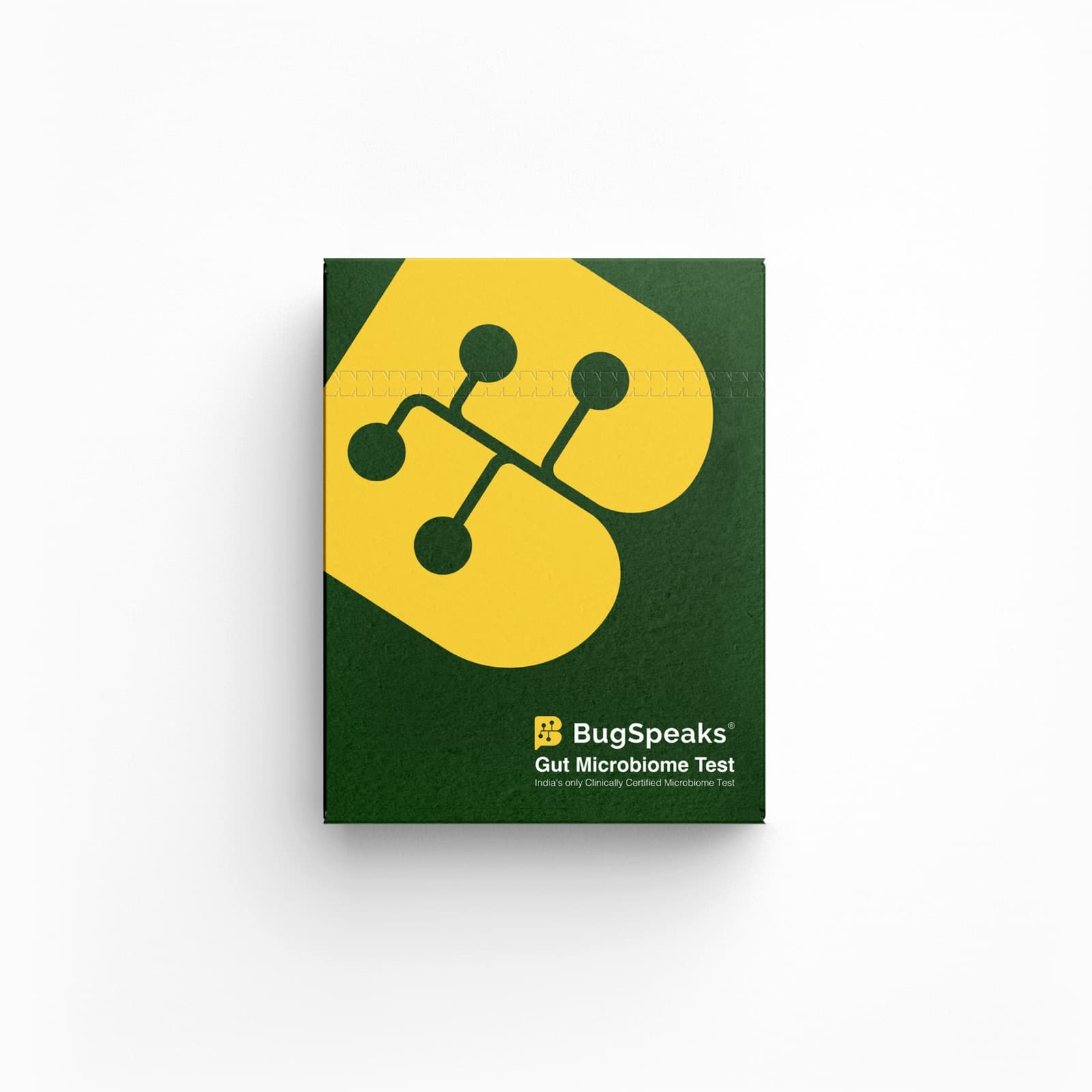
Because the same probiotic does not settle in everyone’s gut in the same way. The BugSpeaks personalised probiotic is a food supplement with live bacterial cultures, chosen by the result of your gut test. The test checks 42 probiotic species in your gut, and your result decides which of a few ready-made formulas suits you. Look out for it soon on the probiotic page.
Why does the same probiotic settle in some people and not in others?
Because of the microbes that already live in the gut. About 38 trillion bacteria live in your body, most of them in the large intestine, and every probiotic lands among them.
Scientists at the Weizmann Institute in Israel gave volunteers a mix of 11 probiotic strains and took samples directly from the lining of their gut. The bacteria passed alive through the stomach and intestines, but in some people they settled in the gut lining and in others they hardly did. Settling differed by person, by section of the gut and by strain. Which group a person would fall into could be predicted from their microbes and some features of their body before they started. The authors conclude that new, personalised approaches to probiotics are needed.
In another study, one strain of Bifidobacterium longum stayed in the gut for at least 6 months in 30% of people, but not in the rest. Whether it stayed depended on the microbes the person already had.
The same strain stayed in 3 out of 10 people
The strain Bifidobacterium longum AH1206 stayed in the gut for at least 6 months in 30% of people, but not in the other 70%.
A 2026 analysis of 51,244 samples from 45 countries reached the same conclusion for bifidobacteria, which are widely used in probiotics. From the microbes people already had, the authors predicted whether the bifidobacteria from a probiotic would stay or increase in 9 of 13 cases from eight studies. Science is already building ways to predict how each person will respond.
That is why the BugSpeaks personalised probiotic starts with your gut test.
Who is the personalised probiotic for?
For anyone who wants to choose a probiotic based on their own data. If you already take a probiotic, you may be taking species you already have plenty of, while others are under-represented. The gut report shows which probiotic species are well represented in you and which are under-represented, and the personalised probiotic is chosen from that result. It suits you if:
- you take probiotics and want to know which species you already have;
- you will follow the 12-week nutrition plan that comes with the test and want the supplement to run alongside it;
- you want to compare your microbiome profile with a second test after about three months.
How will the probiotic be chosen for you?
- You take the gut test at home. The sample takes about 5 minutes.
- The report checks 42 probiotic species: 21 lactobacilli, 7 bifidobacteria and 14 others, including Akkermansia muciniphila and Saccharomyces boulardii. Among the lactobacilli is Lactobacillus bulgaricus, the bacterium used to make yoghurt.
- In the “Probiotic Supplementation Summary” each species gets one of five labels, from “Absent” through “Optimal” to “Atypical High”, with a short piece of advice: consider a supplement, follow the recommendations, carry on as you are or avoid supplements with that species. Right in the summary at the start, the report lists the species that are under-represented in you.
- Your result decides which of a few ready-made formulas suits you, and you receive a 12-week course.
All 42 probiotic species the test checks
Lactobacilli (21)
- Lactobacillus acidophilus
- Lactobacillus amylovorus
- Lactobacillus bulgaricus
- Lacticaseibacillus casei
- Lactobacillus caucasicus
- Lactobacillus crispatus
- Lactobacillus delbrueckii
- Lactobacillus gallinarum
- Lactobacillus gasseri
- Lactobacillus helveticus
- Lactobacillus jensenii
- Lactobacillus johnsonii
- Lacticaseibacillus paracasei
- Lactobacillus pentosus
- Lactobacillus lactis
- Lactiplantibacillus plantarum
- Lacticaseibacillus rhamnosus
- Levilactobacillus brevis
- Ligilactobacillus salivarius
- Limosilactobacillus fermentum
- Limosilactobacillus reuteri
Bifidobacteria (7)
- Bifidobacterium adolescentis
- Bifidobacterium animalis
- Bifidobacterium bifidum
- Bifidobacterium breve
- Bifidobacterium infantis
- Bifidobacterium lactis
- Bifidobacterium longum
Other probiotics (14)
- Akkermansia muciniphila
- Bacillus clausii
- Bacillus coagulans
- Bacillus indicus
- Bacillus subtilis
- Clostridium butyricum
- Enterococcus faecium
- Lactococcus lactis
- Leuconostoc mesenteroides
- Pediococcus acidilactici
- Saccharomyces boulardii
- Saccharomyces cerevisiae
- Streptococcus salivarius
- Streptococcus thermophilus
What will you get?
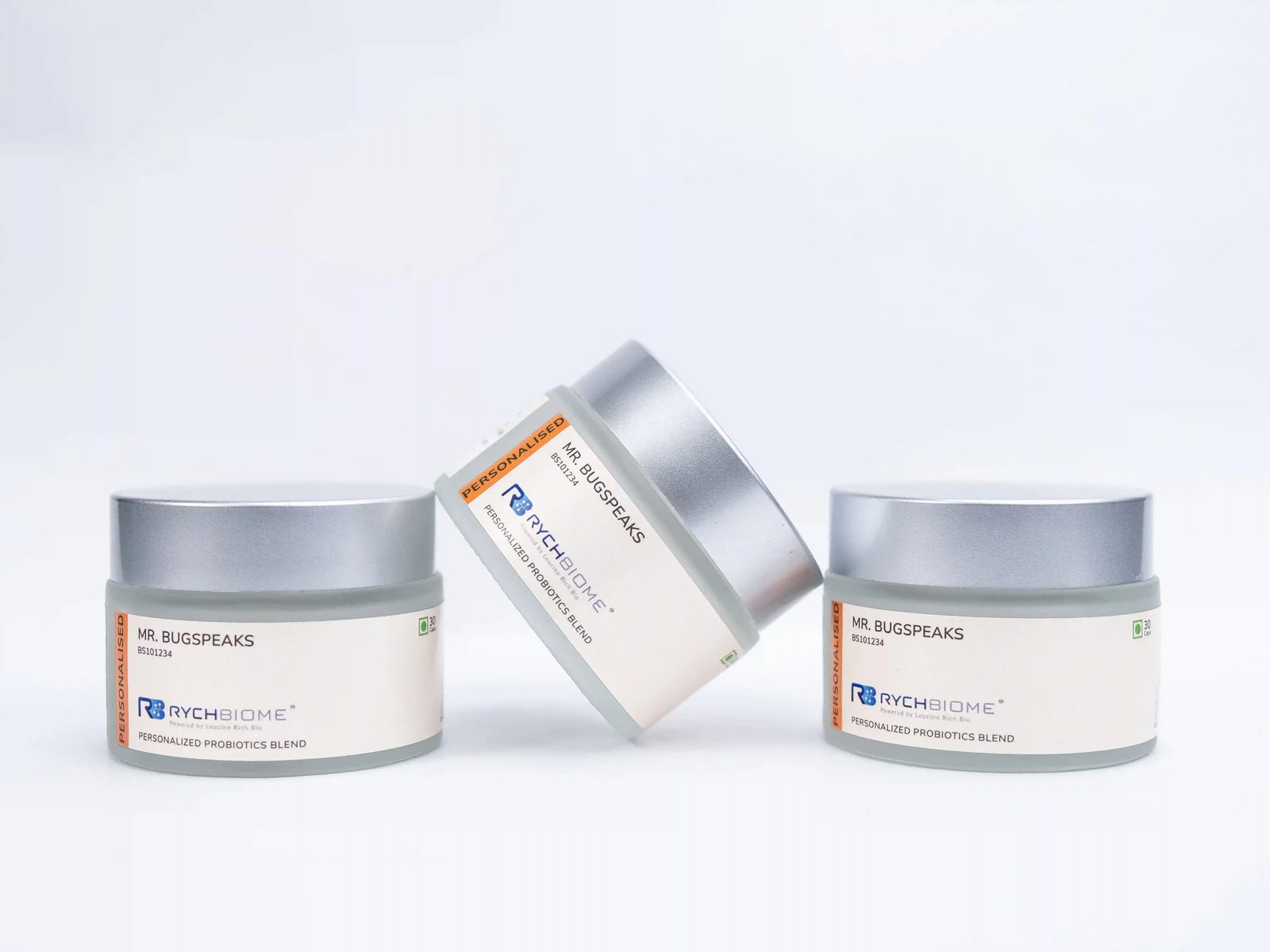
A box with 3 jars for 12 weeks and instructions for taking it. The course lasts as long as the nutrition plan that comes with the gut test, so the supplement and your diet run side by side.
The plan shows which prebiotic and probiotic foods, and supplements where needed, suit you based on which species are under-represented in your profile. It also includes fermented foods such as yoghurt, kefir and sauerkraut, each with a colour for how often to eat it in each phase. Which foods carry live bacteria is covered in our article on 10 probiotic foods.
If you want to see how your microbiome changes, choose the bundle with two gut tests: you take the second one after about three months to compare your microbiome profile.
How much will the personalised probiotic cost?
€290 on its own, once you already have a gut test result. If you take it together with the test, it comes to €240: the “Gut Test + Personalised Probiotic” bundle is €600 instead of €650. The “Two Gut Tests + Personalised Probiotic” bundle is €900 instead of €1010, so you save €110. Delivery is free.
With the gut test, the probiotic costs €50 less
The “Gut Test + Personalised Probiotic” bundle is €600 instead of €650.
On its own the probiotic will cost €290, and together with the gut test €240, so the bundle is €600 instead of €650.
What else the gut test shows is covered in our article on the test.
This article is for educational purposes and does not replace advice from a doctor.
Sources (6)
- [1]Zmora N, Zilberman-Schapira G, Suez J et al., 2018. Personalized Gut Mucosal Colonization Resistance to Empiric Probiotics Is Associated with Unique Host and Microbiome Features. Cell.
- [2]Maldonado-Gómez MX, Martínez I, Bottacini F et al., 2016. Stable Engraftment of Bifidobacterium longum AH1206 in the Human Gut Depends on Individualized Features of the Resident Microbiome. Cell Host & Microbe.
- [3]Goswami S, Ansari A, Sharaf C et al., 2026. Gut microbiome features associated with Bifidobacterium colonization predict personalized probiotic persistence patterns. Nature Communications.
- [4]Sender R, Fuchs S, Milo R, 2016. Revised Estimates for the Number of Human and Bacteria Cells in the Body. PLoS Biology.
- [5]Fisberg M, Machado R, 2015. History of yogurt and current patterns of consumption. Nutrition Reviews.
- [6]BugSpeaks gut test sample report, Bulgarian edition (anonymised, 48 pages).