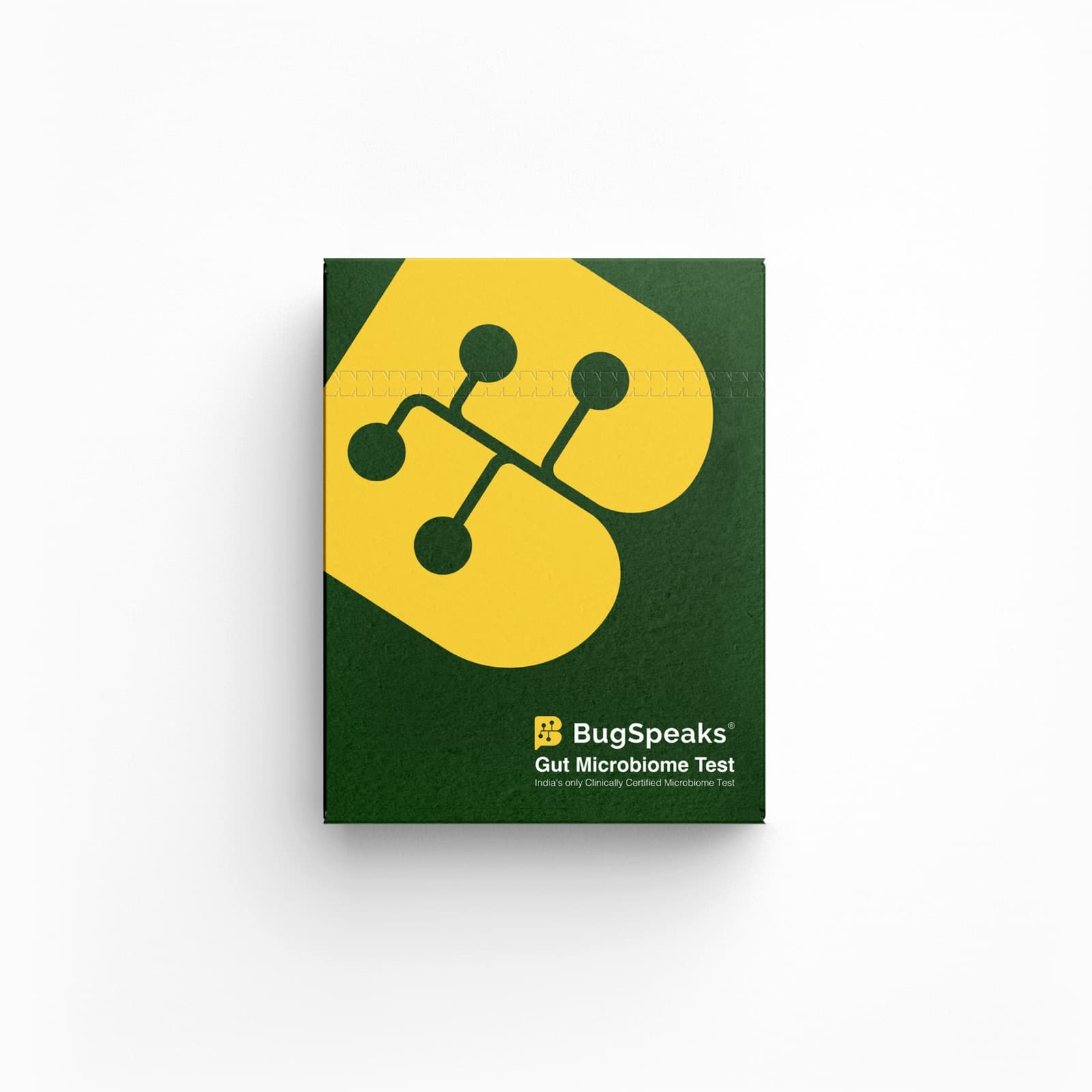
You order the test
You order online. A courier delivers the kit discreetly to your door — within 2 working days, usually the next day.
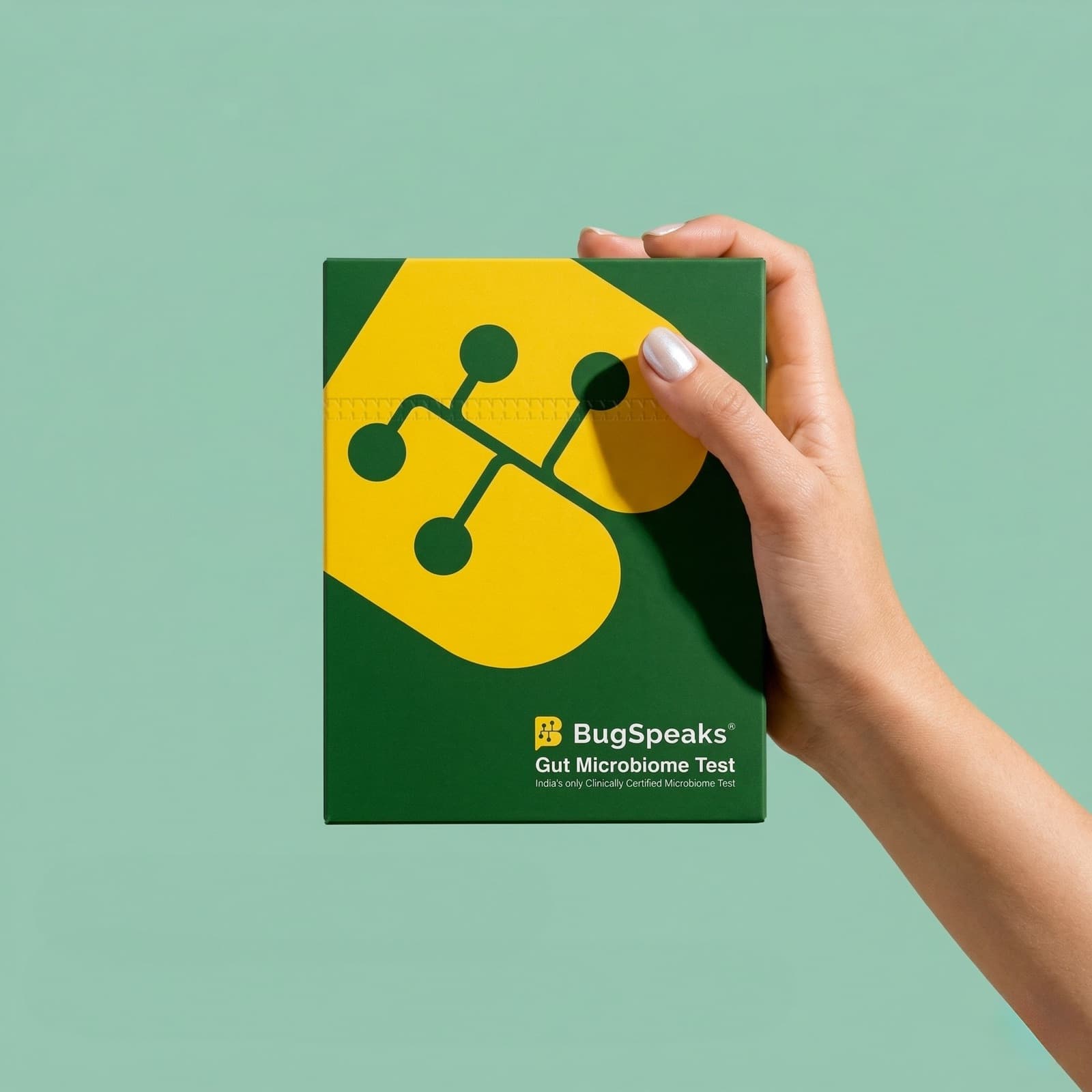
An analysis of all the DNA in your sample — not just the bacteria.
Trillions of microbes live in your gut. They break down your food, produce vitamins and short-chain fatty acids, and take part in the conversation between gut and brain. BugSpeaks reads their DNA, identifies them down to species level and turns all of it into 48 pages that say what is happening inside — and what to change at the table.
A plan with a published study
Three phases across 12 weeks. About 250 foods in 11 groups, each with an exact frequency, and meals set out by time of day with portions. The approach was clinically tested in a pilot study by Leucine Rich Bio with 30 participants (PeerJ, 2024), funded by the company.
Over 100 indicators, calculated from your sample
Your microbes' potential for vitamins, short-chain fatty acids and neurotransmitters, how they break down lactose, fructose, gluten and histamine, five health indicators from fatigue to the gut barrier, and how closely your microbes resemble those seen in 8 common conditions. Not one conclusion, but a whole profile.
Rych Index™ — one number you can track
Your gut health from 0 to 100 against the laboratory's reference group. You know where you start, and with a repeat test you see in black and white how it changes.
We read every bit of genetic material in the sample
Shotgun metagenomic sequencing reads the DNA in the sample without pre-selection — of bacteria, archaea, fungi and viruses — down to species level for the microbes with enough DNA. That is why the report can name the specific microbe, not just its genus.
You order
The courier delivers the kit within 2 working days — usually the next day, discreetly packed.
You take the sample at home
A few minutes, with no appointment needed. The exact steps are in the instructions in the box.
You send it back free
Free of charge, with Econt. The laboratory runs shotgun sequencing on the sample.
You get the report
Within 16 working days of receiving your sample — in your account, with the personalised recommendations.
 You save €50 by buying them together
Coming soon
A personalised probiotic for 3 months
A food supplement: a fully individual probiotic formula with live bacterial cultures, created specifically for you based on the probiotic species missing from your gut test. That is why it is ordered with the test: it is sent once the report is ready.
A one-off price. No subscription, no hidden fees.
The data first. Then the plan.
What the microbes in your gut do cannot be seen by eye. The report assesses your microbes' potential linked to intestinal motility and how they break down lactose, fructose, gluten and histamine. From that data the 12-week plan chooses your foods and how often to eat them. You also see how strong your gut barrier is according to your microbes and whether microbes linked to inflammation are overgrowing in your gut.

The microbiome test is informational and does not provide a diagnosis. The report shows what was found in your sample.
What you get
The report turns millions of sequenced DNA fragments into concrete, understandable indicators — ordered from the big picture down to the detail. Click on any of them for more.
PDF · 9 MB · earlier report version
Everything starts here. The report compares your microbiome with healthy reference groups and boils it down to a score from 0 to 100. You see at once where you stand — and, with a repeat test, whether you are moving in the right direction.
Rych Index™ · gut health score
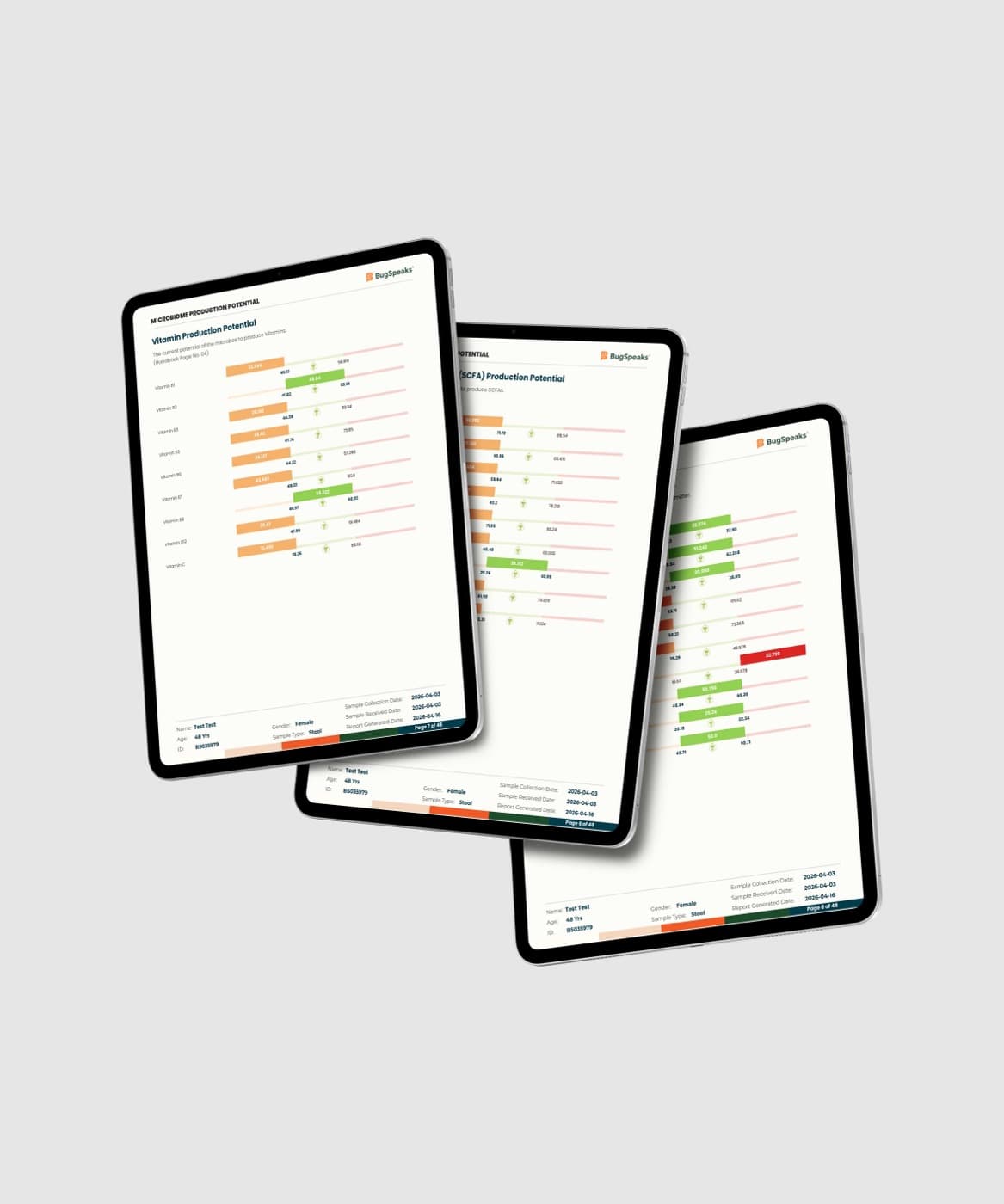
sample resultThe bacteria in your gut don't just live there — they work. They produce short-chain fatty acids that feed the gut wall, B vitamins and neurotransmitters that research links to the gut–brain axis. The report assesses their potential for each.
9 indicators — butyrate, acetate, propionate, caproate, valerate, isobutyrate, isovalerate, 2-methylbutyrate and formate.
Butyrate is a main source of energy for the cells of the large intestine; propionate takes part in regulating appetite and metabolism; acetate is a source of energy. The report shows your microbes' potential to produce them — not their levels in your body.
9 — vitamins B1, B2, B3, B5, B6, B7, B9, B12 and vitamin C.
Gut bacteria can synthesise part of these vitamins. The report assesses your microbes' potential to produce them — not your vitamin status and not whether you need supplements.
10 — serotonin, dopamine, GABA, acetylcholine, glutamate, histamine, epinephrine, norepinephrine, tryptamine and tryptophan.
Most of the body's serotonin is made by cells of the gut wall, and gut microbes influence this process. The report shows your microbes' potential — not the levels of neurotransmitters in your body.
This is their role in your day-to-day: how they break down fats, carbohydrates and proteins, as well as lactose, fructose, gluten and histamine, how they affect gut motility and the absorption of minerals, and how much they support your endurance.
How your microbiome processes carbohydrates, fats and proteins.
The report assesses your microbes' potential to take part in breaking down the three main macronutrients — carbohydrates, fats and proteins.
The potential for gut motility and for the bioavailability of minerals such as iron, zinc and calcium.
The report assesses your microbiome's potential linked to how the gut moves and its potential to influence the absorption of iron, zinc and calcium from plant foods. It does not measure how much your body absorbs.
How your microbes break down these four substances from food.
The test does not establish an intolerance and is not an allergy test. The report assesses the potential of your gut microbes to break down lactose, fructose, gluten and histamine — the plan uses this data to arrange your foods. If you suspect an intolerance or coeliac disease, the test is ordered by a doctor.
Microbes that research links to aerobic and physical endurance.
For example, a higher share of Faecalibacterium prausnitzii has been linked to better aerobic endurance. This is your microbes' potential, not an assessment of your fitness.
Your gut microbes affect far more than digestion. Here the report brings together five health indicators, from fatigue to the gut barrier, and compares your microbes with the profiles seen in people with eight common conditions. So you see where your microbes work for you and where it is worth helping them.
Whether your microbes help you against fatigue: the species research links to better muscle function and less fatigue.
The report rates it on three levels: low, moderate or high. It is an assessment of your microbes, not a measurement of your energy. If the fatigue does not go away, see a doctor.
How strong your gut barrier is according to your microbes: which species strengthen it and which weaken it.
The gut lining lets nutrients through and holds the rest back. Some bacteria strengthen it, for example with the butyrate they produce, while others weaken it. The report shows their balance in you. It does not measure how permeable your gut is.
Whether microbes linked to inflammation are overgrowing in your gut, and whether you have enough of the beneficial ones that produce short-chain fatty acids.
Research links gut inflammation to two signs in the microbiome: an overgrowth of some microbes and fewer beneficial species that produce short-chain fatty acids. The report rates these signs in you on three levels. It is not a test for inflammation and does not replace the tests a doctor orders.
How much your microbes turn the carnitine and choline in your food into TMA, which the liver turns into TMAO.
Carnitine is found mostly in red meat, choline in eggs and liver. Without gut microbes almost no TMA is formed, so two people eating the same food can have very different levels. The report shows your microbes' potential, not the level of TMAO in your blood.
Species and genes in your microbiome that research links to exposure to microplastics.
Microplastics are now found in food, water and air, and research is finding links between them and gut microbes, including genes and enzymes involved in breaking them down. The report assesses these microbial signs in you. It does not measure the amount of microplastics in your body.
The report shows, as a percentage, how closely your microbes resemble those seen in people with type 2 diabetes, obesity, hypertension, non-alcoholic fatty liver disease, constipation, irritable bowel syndrome, inflammatory bowel disease and rheumatoid arthritis.
Research finds characteristic changes in the microbiome in each of these conditions. The report compares your microbiome with these profiles, so you know which it resembles most and what to keep an eye on. It is not a diagnosis and does not predict whether you will develop any of them.
By name: how diverse your microbiome is, which key and probiotic bacteria you have, what share opportunistic microbes make up and which antibiotic resistance genes your bacteria carry. This is the raw picture everything else comes from.
The Shannon diversity index + the distribution across 5 kingdoms: bacteria, archaea, fungi, eukaryotes and viruses.
Higher diversity usually means a more resilient microbiome. You also see the ratio between the five kingdoms — a detail that 16S tests do not capture, because they analyse only bacteria and archaea.
36 key species whose balance has a large effect on the whole microbiome.
They include Faecalibacterium prausnitzii, Prevotella copri, Roseburia and Bifidobacterium. The report shows the share of each species compared with the reference group.
Which of 42 probiotic species you have and how much: 21 lactobacilli, 7 bifidobacteria and 14 others, including Akkermansia muciniphila.
You see their levels compared with the reference group and which are low. For each species the report notes whether to consider a supplement, carry on as you are, or avoid one.
The relative share of microbes that in healthy people are usually present in small amounts — compared with the reference group.
This is information about the balance of your microbiome — it is not a test for infection or parasites and does not show an infection. If you have symptoms, see a doctor.
Which known resistance genes your bacteria carry (a check across 90 antibiotics), plus your microbiome's potential to recover after antibiotics. Not a prediction of the effect of a treatment.
The report shows which known resistance genes your gut bacteria carry — general information about your microbiome. It does not show whether a given treatment will work, it is not an antibiogram and it is not for choosing an antibiotic.
Which five species dominate in each of the five kingdoms at the time of the test.
A quick look at the dominant species that shape the character of your microbiome at the time of the test — a starting point for tracking changes over time.
Nutrition plan
The report doesn't end with the numbers. The gut test comes with a 12-week nutrition plan calculated from your microbes — an approach clinically tested in a pilot study by Leucine Rich Bio with 30 participants (PeerJ, 2024), funded by the company.
Nutrition plan
Every gut report comes with a personalised 12-week nutrition programme built on your unique microbiome profile — an approach clinically tested in a pilot study by Leucine Rich Bio with 30 participants (PeerJ, 2024), funded by the company. Three phases and about 250 foods in 11 groups, each with how often to eat it.
The process
Four steps from order to a personalised nutrition plan.
You order online. A courier delivers the kit discreetly to your door — within 2 working days, usually the next day.
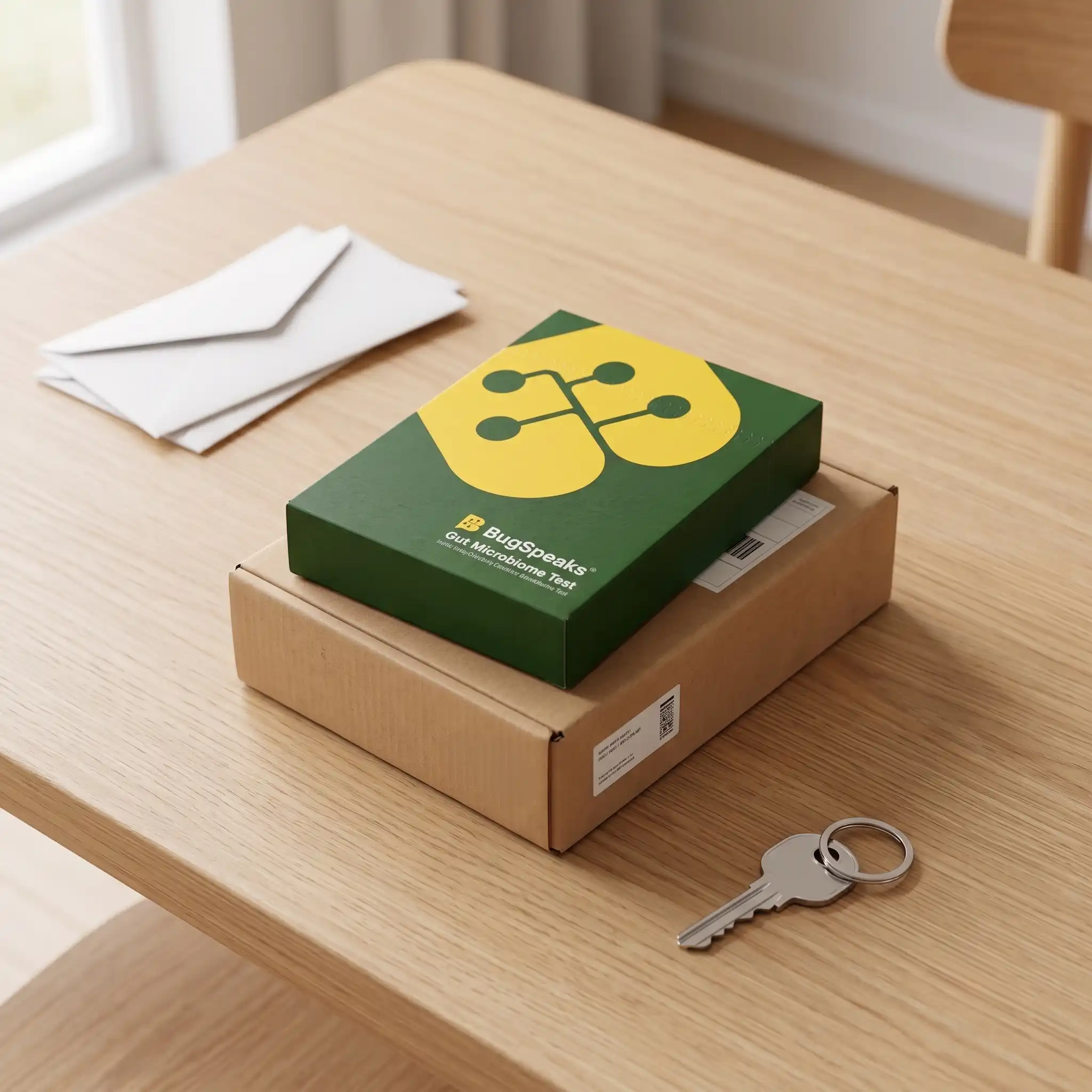
Sterile tools, clear instructions. The whole procedure takes about 5 minutes.

Free return shipping. Your sample travels to the Leucine Rich Bio laboratory for shotgun sequencing.
A digital report with a detailed analysis and a 12-week personalised nutrition plan — in your account within 16 working days of receiving your sample.
Science and trust
The approach behind the BugSpeaks nutrition programme is described in a peer-reviewed publication by scientists from Leucine Rich Bio, the developer of the test (Kallapura et al., PeerJ, 2024) — a pilot study with 30 participants, carried out and funded by the company. The platform builds on peer-reviewed publications.
Reviews
Published with the customers' permission. Results are individual — every microbiome is different.
Toma Tanev
„I slept badly. I never connected it with my plate."
I took the test for digestion — I had written off my sleep. The plan emphasised foods for the gut–brain axis, which sounded like marketing to me. By the second month I was waking up less at night. I am not claiming it was only this, but I changed nothing else.

Stoyan Grigorov
„I bloated every evening and had got used to it."
I had tried plenty at random — gluten-free once, dairy-free another time, always something. The report showed that the bacteria which break down fibre were exactly what I lacked, and the plan started there. For the first three or four weeks I felt nothing. Then the bloating eased enough that I stopped keeping track of it.
Aleksandar Zhelyazov
„I switched off in the afternoons and blamed my age."
Honestly, I did not expect much. The plan was a nuisance at first — I had to buy things I never used. Somewhere in the second month I noticed I no longer reached for coffee at four in the afternoon. I am not a different person, but the day ends more easily.
Maria Todorova
„I tried creams for years without thinking about my gut."
My skin flared up for no clear reason. The report linked it to the state of my gut, so the plan started there rather than with my face. Not everything went away, but the redness calmed down enough that I stopped reaching for concealer every morning.
Kemal Kemal
„I did not go on a diet. I just saw what I was feeding."
I was putting on two or three kilos a year, and every restriction lasted me about a month. The test showed I had been feeding the bacteria that like processed food. The plan did not forbid anything, it rearranged. In five months I lost six kilos — slowly, but for the first time without counting calories.
Toma Tanev
„I slept badly. I never connected it with my plate."
I took the test for digestion — I had written off my sleep. The plan emphasised foods for the gut–brain axis, which sounded like marketing to me. By the second month I was waking up less at night. I am not claiming it was only this, but I changed nothing else.
Stoyan Grigorov
„I bloated every evening and had got used to it."
I had tried plenty at random — gluten-free once, dairy-free another time, always something. The report showed that the bacteria which break down fibre were exactly what I lacked, and the plan started there. For the first three or four weeks I felt nothing. Then the bloating eased enough that I stopped keeping track of it.
Frequently asked questions
BugSpeaks is a wellness product. The results show the composition and functions of the microbiome; they are not a medical test and are not intended to diagnose, prevent or treat disease. If you have health concerns, see a doctor. Read the full medical disclaimer.
Two ways to begin. If your complaints are about digestion or energy, start with the gut. If they show on your skin — start there.