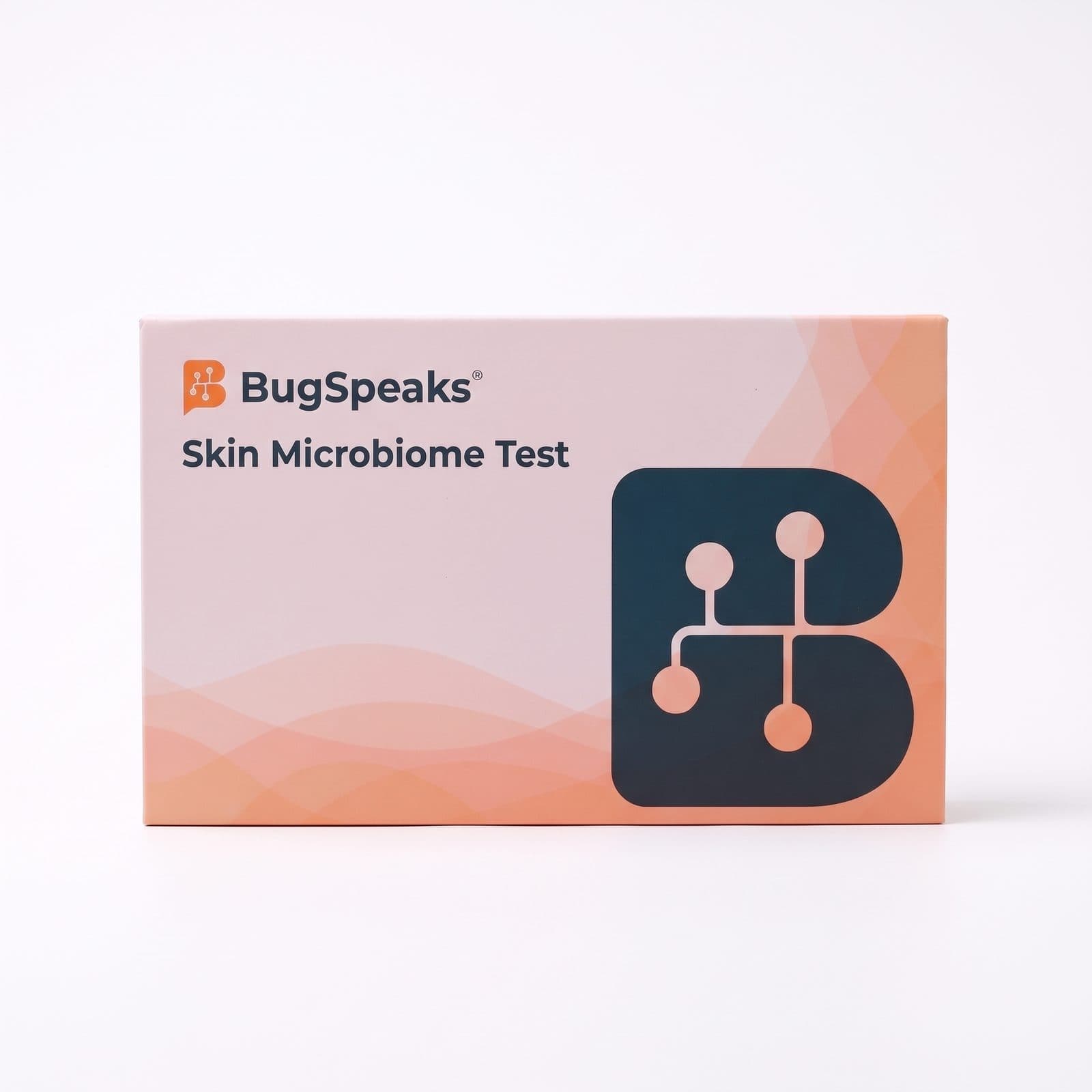
From the BugSpeaks skin microbiome test you will learn how much the microbes on your face help your skin and how to care for it based on them. You get a 25-page report with 11 skin traits summed up in 5 scores, the microbes that live on your skin, and ingredients, probiotics and foods chosen for your result. The sample is a swab from your face that you take at home in about 2 minutes.
What makes this test different?
The skin test uses the same shotgun metagenomic analysis as the gut test: the Leucine Rich Bio laboratory reads the DNA of all the microbes in the swab. The commonly used 16S method reads one gene, misses everything that is not a bacterium or an archaeon and gives little data on what the microbes do. Shotgun analysis also sees fungi and viruses and shows what the microbes can do. That is why the 37 species under “Opportunistic microbes” in the report include 22 species of fungi that a 16S analysis would not see.
A skin sample is hard to analyse this way, because skin carries little microbial DNA and a lot of human DNA. That is why the sample is taken by clear rules: in the morning, before you wash your face.
The recommendations are personal. The ingredients, extracts, probiotics and foods in the report are chosen from your scores, so they differ from one person to the next. Every trait is explained twice: once for you and once for your dermatologist or beautician.
What will you learn about your skin?
The report is 25 pages long and draws on 21 scientific references. It starts with the “Skin Wellness Scorecard”: the five summary scores and the 11 traits on one page. Each trait is a score from 0 to 100 for the potential of the microbes on your skin, calculated from their genes. Here are the five scores and the traits in each:
- “Barrier strength”: how well your microbes protect the top layer of your skin. It includes “Epidermal integrity”, “Ceramide production” and “pH maintenance”.
- “Hydration”: how much they help your skin hold on to moisture. It includes “Moisture retention”, “Ceramide production”, “Epidermal integrity” and “Sebum regulation”.
- “Sensitivity”: how calmly your skin copes with irritants. It includes “Irritation tendency” and “Reactivity and tolerance”.
- “Repair and recovery”: protection from free radicals, the sun and pollution. It includes “Antioxidant defence” and “Photoprotection and resilience”.
- “Ageing and preservation”: how much your microbes help your skin stay firm and elastic. It includes “Collagen production”, “Elasticity maintenance”, “Antioxidant defence” and “Photoprotection and resilience”.
Then come the microbes themselves: the “Shannon Diversity” of your skin microbes and the share of the five kingdoms, bacteria, archaea, fungi, eukaryotes and viruses. Under “Opportunistic microbes” you see the share of 37 species, 15 bacteria and 22 fungi, that are usually present only in small amounts on healthy skin. This is the share of their DNA in the sample, not a diagnosis. All three are compared with reference groups of healthy people from different parts of the world.
All 37 species
Bacteria (15)
- Corynebacterium diphtheriae
- Staphylococcus aureus
- Streptococcus pyogenes
- Treponema pallidum
- Aeromonas hydrophila
- Serratia marcescens
- Stenotrophomonas maltophilia
- Actinomadura madurae
- Actinomyces naeslundii
- Actinomyces viscosus
- Actinomyces israelii
- Eikenella corrodens
- Morganella morganii
- Bartonella henselae
- Bartonella quintana
Fungi (22)
- Fonsecaea erecta
- Fonsecaea monophora
- Malassezia globosa
- Malassezia restricta
- Rhinocladiella mackenziei
- Scedosporium apiospermum
- Fusarium oxysporum
- Trichoderma citrinoviride
- Blastomyces dermatitidis
- Trichophyton rubrum
- Candida albicans
- Exophiala spinifera
- Malassezia sympodialis
- Microsporum canis
- Trichoderma harzianum
- Fonsecaea nubica
- Exophiala dermatitidis
- Sporothrix schenckii
- Fonsecaea pedrosoi
- Talaromyces marneffei
- Purpureocillium lilacinum
- Trichoderma atroviride
This is the share of their DNA in the sample, not a diagnosis.
Finally, your scores turn into skincare:
- “Primary topical ingredients” for serums and creams, each with a reason why it was chosen and alternatives in case you are allergic to it.
- “Natural topical extracts” and “Topical probiotic lysates” to look for in your cosmetics.
- “Oral probiotic recommendations” and “Dietary recommendations”, chosen from the analysis of your skin.
- “General guidelines”: a 4-step routine (cleanser, serum, moisturiser and sunscreen) and which ingredients not to mix.
For even more precise nutrition guidance, the report itself also recommends a gut test. How the gut affects the skin is covered in our article on the gut–skin link.
How does it work?
- You order from the test page. The kit arrives with Econt at an office, an Econtomat locker or your address within 2 working days, with a sterile swab and illustrated instructions. You send the sample back free of charge with Econt: a courier to your door or an office.
- The evening before, you wash your face only with water or a mild cleanser and apply nothing afterwards.
- In the morning, as soon as you get up and before you wash, you take the swab in about 2 minutes and send it back free of charge. The laboratory sees only the test code, never your name.
- Within 16 working days of receiving your sample, the report is in your account. We email you as soon as it is ready.
Four surprising facts about the microbes on your skin
The microbes on your skin give away your age. American scientists trained a computer model to guess the age of adults from their microbes. From the microbes on the skin of the hands and forehead it was off by 3.8 years on average, from those in the mouth by 4.5 years and from those in the gut by 11.5 years.
Skin microbes give away your age most accurately
The average error, in years, with which the model guessed age. The smaller it is, the more accurate.
From the microbes on the skin of the hands and forehead the model was off by 3.8 years on average, from those in the mouth by 4.5 years and from those in the gut by 11.5 years.
Source: Huang et al., mSystems, 2020
Scientists are only beginning to study what lies behind this link. The skin report does not calculate the age of your skin, but it shows how much your microbes help with collagen and elasticity.
- The microbes on your skin are personal and stable. Studies using shotgun analysis find that the bacteria, fungi and viruses on each person’s skin carry their own signature and stay largely the same over months and years, even though the skin is exposed to the outside world. People keep their own microbes instead of picking them up again from outside.
- One skin bacterium helps make ceramides. Staphylococcus epidermidis, one of the most abundant microbes on the skin, releases an enzyme that helps the skin produce ceramides, the main building block of the barrier that keeps it from drying out. In mice it raised ceramide levels and reduced water loss from damaged skin. “Ceramide production” is one of the 11 traits in the report.
- The gut and the skin influence each other in both directions. Scientists call this link the gut–skin axis, and so far they have mostly studied how gut microbes and diet affect the skin. The skin report also recommends a gut test, for more precise nutrition guidance.
How much does the skin microbiome test cost?
€360, one-off, with no subscription. The price covers the kit, the free return of the sample, the analysis and the report. If you take it together with the gut test, the two cost €620 instead of €720, so you save €100.

With the bundle you get two reports, one for your skin and one for your gut, and the gut report comes with a 12-week nutrition plan and five health indicators. What else the gut test shows is covered in a separate article.
This article is for educational purposes and does not replace advice from a doctor.
Sources (7)
- [1]Plaza Oñate F, Quinquis B, Thirion F et al., 2025. Assessment of protocols for characterization of the human skin microbiome using shotgun metagenomics and comparative analysis with 16S metabarcoding. Microbiology Spectrum.
- [2]Huang S, Haiminen N, Carrieri AP et al., 2020. Human Skin, Oral, and Gut Microbiomes Predict Chronological Age. mSystems.
- [3]Oh J, Byrd AL, Deming C et al., 2014. Biogeography and individuality shape function in the human skin metagenome. Nature.
- [4]Oh J, Byrd AL, Park M et al., 2016. Temporal Stability of the Human Skin Microbiome. Cell.
- [5]Zheng Y, Hunt RL, Villaruz AE et al., 2022. Commensal Staphylococcus epidermidis contributes to skin barrier homeostasis by generating protective ceramides. Cell Host & Microbe.
- [6]Jimenez-Sanchez M, Celiberto LS, Yang H et al., 2025. The gut-skin axis: a bi-directional, microbiota-driven relationship with therapeutic potential. Gut Microbes.
- [7]BugSpeaks skin report, Leucine Rich Bio (sample report, 25 pages).